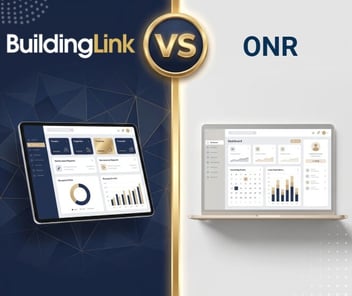
BuildingLink and Condo Control both show up on the same shortlists of community management software options, but they're built for different sized operations. BuildingLink is built around staffed buildings: front desks, package rooms, key cabinets, vendor coordination, portfolio reporting, and integrations into the accounting stacks property management companies actually use. Condo Control is built around self-managed and lightly staffed HOAs that need clean communication, dues collection, and amenity booking without much overhead.
Both work. The question is which one matches how your community runs today and what you'll need from a platform two or three years out.
We've spent over 25 years working with condos, co-ops, multifamily, and HOAs, so this comparison reflects what we've actually seen hold up (and break) in production. We'll call out the places where Condo Control may be an appropriate fit, as well as where BuildingLink may suit business needs better.
Quick Verdict
Pick Condo Control if:
- You're a small, self-managed HOA, typically under 100 units, with no on-site staff
- Your day-to-day needs are owner communication, dues collection via QuickBooks, and amenity reservations
- A published entry-level price matters more to your board than long-term integration depth
- You don't expect to add a front desk, package management, or portfolio reporting in the next 24 months
- You have any combination of front desk, package room, key cabinet, or staffed concierge running daily
Pick BuildingLink if:
- You have any combination of front desk, package room, key cabinet, or staffed concierge running daily
- You need native payments and accounting sync into Yardi, MRI, Entrata, OneSite, or Rent Manager
- You want resident, manager, and staff access across web and mobile, with custom-branded apps as an option
- You manage multiple properties under one company and need portfolio-wide reporting
- You're running condos, co-ops, multifamily, or single-family HOAs (or a mix) and want one platform across all of them through ManageHOA
We will get into more of a breakdown below on where each product wins, and where the trade-offs are.
Why BuildingLink consistently passes the sniff test
There are four pillars our customers usually point to when they tell us why they picked BuildingLink. The same four show up on the comparison shortlist every time.
Innovation: Over 25 years of building real PropTech
BuildingLink launched in 1999, before the iPhone, before the cloud, before “PropTech” was a category. The platform has shipped through every major shift in residential operations and grown alongside the industry. The codebase is mature, the customer base is 7,500+ communities, and the roadmap is funded by recurring revenue from the largest management companies in the world.
Condo Control was founded in 2008. It has built a real business and serves thousands of HOAs. It is also a smaller team operating on a smaller customer base, which shows up in places like reporting tools, document libraries, and the rate at which net-new modules ship.
Pedigree is not a feature on a checklist. It is the answer to “will this vendor still exist, and still be investing, in five years?” That answer matters when a board signs a multi-year contract.
Breadth and depth: 67+ modules built for real building life
BuildingLink offers the largest module set in the industry, built around the work buildings actually run every day: service requests, package logging, key tracking, amenity bookings, inspections, vendor coordination, and resident communications.
Condo Control’s 40+ module list covers the central use cases. Buildings that run beyond those use cases (which is most condos and co-ops with staff) start hitting “we need to track that elsewhere” within the first few months of going live.
Customer support: industry-leading training and onboarding
BuildingLink comes with implementation and onboarding included, plus a Premier Support tier for buildings that want a dedicated success contact. The quality of BuildingLink's customer support is consistently praised in online reviews, with customers highlighting the depth of help available and the responsiveness of the team.
That matters more than people expect. Software is only as good as the team helping you set it up and the people who answer when something goes wrong on a Friday afternoon. A platform that demos well in 30 minutes is a different product than one that supports a board through three years of operations.
Integrations: built for the way real management companies operate
This is where the two platforms diverge most sharply. BuildingLink integrates across five operational categories with named partners in each. Condo Control's integration footprint is concentrated around QuickBooks plus a smaller partner set. If your back office is mostly QuickBooks and you don't expect to add badged access, package lockers, or enterprise accounting in the next two to three years, Condo Control's tighter integration set will likely cover what you need. If you're already running any of those systems, the depth of BuildingLink's integration footprint shows up in the day-to-day handoff between tools.
A few BuildingLink integrations worth understanding more deeply:
Accounting. BuildingLink syncs resident balances, transaction history, and work order data between the platform and the connected accounting system automatically. Work orders flow into the accounting system in real time, which matters for management companies that close month-end on such bookkeeping software.
Access control. BuildingLink centralizes resident access assignments, syncs them into Brivo without duplicate entry, and revokes access automatically when a resident is deactivated. This eliminates the most common access-control failure mode: orphaned credentials after a move-out.
Package lockers + ImageR. Pair Luxor One, Package Concierge, or Snaile with ImageR (OCR scanning of shipping labels inside the BuildingLink mobile app) and the front desk logs packages in one tap instead of typing tracking numbers.
Payments. BuildingLink Payments is native to the platform, but BuildingLink also supports Zego, ClickPay, PayLease, and Stripe for buildings with existing processor relationships.
Condo Control's QuickBooks integration is well-executed and worth crediting. If QuickBooks is the only accounting system you'll ever need, that's a real strength on their side. Most growing management companies will eventually outgrow that footprint, but for communities that won't, it's more of a fit.
What you will see on the Condo Control side
A Condo Control demo will land cleanly on a few things. Here's what to expect, and what's worth a second look:
- Published entry-level pricing. A $67.50/month starter tier sits on their pricing page. BuildingLink quotes by building because every property is sized differently, and we package in Essential, Gold, and Premier tiers to match the operation. The starter price you see on Condo Control’s site is rarely the all-in cost for a real community once modules are added, as there is also a charge for additional support after the initial training when launching a building.
- A clean QuickBooks integration. Condo Control was built around QuickBooks, and that integration is mature. BuildingLink supports QuickBooks too and adds the enterprise accounting depth that QuickBooks-only platforms do not reach.
- Approachable interface for first-time users. Self-managed HOAs and small boards can pick up the basics quickly without a heavy training lift. BuildingLink ships its own resident and staff apps with the same usability bar, plus custom-branded mobile options for management companies that want the resident experience to live under their own brand.
Here's the candid read on Condo Control's limits, based on what online reviewers keep flagging and what we hear from prospects who've switched to BuildingLink:
- Reporting is awkward. Reviewers consistently flag limited search across complaints, incidents, and historical records. Boards that need clean trend data feel this fast.
- Document libraries are tight. Users report file-size limits and weak organizational tools. Bylaws, financials, meeting minutes, and architectural files add up.
- Setup is rigid. Once configured, certain settings are hard to change without support help. Reorganizing a custom field becomes a ticket.
- Front-desk tooling is light. Visitor management exists. Real key tracking, offline desk operations, and digital staff tipping do not. For staffed buildings, that gap shows up the day operations stress-test the software.
Five common decisions, side by side
A 250-unit luxury condo with a 24-hour staffed lobby
This is BuildingLink’s home turf. Concierge log, ImageR for package OCR, KeyLink for the key cabinet (146 million keys tracked across 1,400+ buildings), TippingLink for staff appreciation, custom-branded mobile app for residents, and ConciergeLink to keep the front desk running through internet outages. Every piece of the operation has a purpose-built tool.
A platform without dedicated key, tipping, or offline desk tools will fall short of what residents and staff expect at this tier.
An 80-home single-family HOA in suburban Atlanta
ManageHOA by BuildingLink is purpose-built for single-family and townhome communities. Architectural review workflow, violation tracking, community directory, recurring tasks, vendor directory, and a resident app that fits yard-and-driveway issues. Boards get analytics and reports that hold up to budget season.
A general-purpose HOA tool can cover the basics. ManageHOA was designed for this exact community profile, which means fewer workarounds and more fit.
A self-managed 40-unit condo with a volunteer board, no staff, and QuickBooks accounting
BuildingLink’s Essential package is built for this profile: manager dashboard, service requests, email and SMS broadcasting, accounting integration, resident dashboard, event calendar, and payment integration. Self-managed boards get the modules they actually need without paying for staff tooling they will not use.
A QuickBooks-only competitor may look cheaper at sticker price. The board has to decide whether they want a vendor that can grow with them if the community ever adds staff, expands amenities, or joins a management company.
A regional management company running 25+ properties
BuildingLink, with portfolio mode (Superusers), Premier Support, custom-branded apps, and the enterprise accounting integrations that let you standardize across Yardi, MRI, Entrata, or Rent Manager. Brivo and Salto for access. Luxor One and Package Concierge for lockers. Custom Fields and Customizations services for the workflows specific to your portfolio.
A single-product platform with a smaller integration footprint creates operational drag at portfolio scale. Standardizing 25 properties on a tool with limited reporting is a quarterly headache.
A mixed-use 600-unit multifamily with retail tenants on the ground floor
BuildingLink’s multifamily customers log over 3 million resident portal logins, 195,000+ amenity reservations, 370,000+ maintenance requests, and 4 million+ packages every year. Multifamily is in the core platform. The leasing-friendly accounting integrations (Yardi, Entrata, OneSite) matter here. The front-desk tools matter here. This is what BuildingLink was built for.
How to actually decide
Three questions worth answering before the next demo:
Do you have a front desk, a key cabinet, or staff who log shifts? If yes, the operational tooling on BuildingLink (KeyLink, TippingLink, ConciergeLink, ImageR, Shift Log) is built for exactly that operation. A platform without those modules will run thinner the more your staff uses the software.
What will your accounting stack look like in two years? If you expect to stay on QuickBooks forever and run one community, both platforms can connect. If you expect to grow into enterprise platforms such as MRI, Entrata, or Rent Manager, BuildingLink’s integration depth saves you a future migration.
How will the platform feel for your residents and your board? Take both demos. Bring your front-desk lead, your maintenance lead, and one board member. Run through the workflows you actually use. The right platform is the one that fits how your community already operates, with room to grow.
Run a better building
The shortlist for residential property platforms has not changed much in the last decade. BuildingLink and Condo Control both belong on it. The difference between them is depth, integrations, and the operational tooling that buildings with real staff and real residents actually use.
If you manage condos, co-ops, multifamily, or single-family HOAs and you want a platform built for the next decade of that work, BuildingLink is built for you. Take the demo with the people who'll actually use the software. The decision gets clear fast when everyone who will actually use the software tries the product together. An hour with all key stakeholders beats a week (or longer) of feature-checking on PDFs. Whichever direction you go after that, you'll have made the call with the right people in the room.
FAQs
BuildingLink quotes by building and packages into three tiers (Essential, Gold, Premier), so you only pay for what your operation actually uses. Condo Control publishes a $49/month starter price, with tiered plans above that. Once a real community adds the modules they need, the platforms typically land in the same per-unit range. The difference is what you get included.
It can run there in the literal sense. The operational fit is loose because the platform’s concierge, key, and staff tooling is lighter than a high-rise actually needs. High-rise communities tend to outgrow Condo Control quickly. BuildingLink was built for the high-rise resident experience from day one.
The largest gaps are enterprise accounting integrations (MRI, Entrata, Rent Manager, OneSite, and more), access control hardware (Brivo, Salto KS, TLJ), package locker partners (Luxor One, Package Concierge, Snaile), and smart home (Ecobee, Alexa, Aware Buildings). BuildingLink also runs native BuildingLink Payments alongside integrations with Zego, ClickPay, PayLease, and Stripe.
Yes. BuildingLink’s accounting integration roster includes QuickBooks alongside enterprise platforms. Communities that live entirely in QuickBooks today get the integration they need, plus a path forward if they ever scale into Yardi, MRI, or another enterprise tool.
It can run there in the literal sense. The operational fit is loose because the platform’s concierge, key, and staff tooling is lighter than a high-rise actually needs. High-rise communities tend to outgrow Condo Control quickly. BuildingLink was built for the high-rise resident experience from day one.