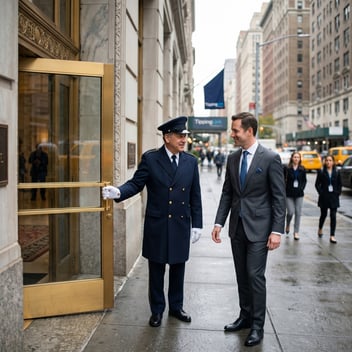
For decades, holiday tipping for building staff ran on cash. A resident folded a few bills into a card, handed it to the doorman or the super in December, and that was the whole system. It worked because everyone carried cash. That last part is no longer true.
Residents still appreciate the people who run their property. What has changed is the money in their pockets. As cash disappears from daily life, the year-end envelope gets harder to pull together, and the staff who count on it are the ones who feel the gap. For a property manager, that is a quiet problem worth solving before December arrives.
Run your community better
New guides on property operations, board decisions, and resident experience, sent the moment we publish them.
Holiday tipping for building staff was built on cash
Year-end tipping is one of the oldest traditions in residential properties. Doormen, concierge, porters, supers, maintenance techs, and valet staff get recognized for a year of holding packages, hailing cabs, and fixing the radiator at 6 a.m. In most buildings, that recognition has always moved as cash inside a card, and residents still ask every December how much each role should get.
Cash worked because it was immediate, personal, and private. The resident handed it over directly, said thank you, and the moment was done. No app, no paperwork, no one else in the middle.
The catch is that the entire ritual assumes the resident has bills on hand in December. For a long time that was a safe assumption. It is not anymore.
Cash is leaving, and your highest-tipping residents are leading the exit
The Federal Reserve tracks this every year. In its 2026 Diary of Consumer Payment Choice, released in May, consumers used cash for about 13% of their payments, roughly 6 transactions out of 47 a month, while cards accounted for two-thirds of everything.
The bigger shift is who has stopped carrying it. A Pew Research Center survey found that 41% of Americans make none of their weekly purchases with cash, up from 24% a decade earlier. Among households earning $100,000 or more, that figure reaches 59%.
Read that income line again, because it matters for staffed properties. The residents most expected to tip a doorman at the holidays are the same higher-earning households that have gone the most cashless. The people who traditionally fill the envelope are the least likely to be carrying anything to put in it.
When the cash is not there, the tip quietly shrinks
Here is how the gap actually shows up. A resident fully intends to tip. They plan to stop at the ATM, then a busy December gets in the way, and the envelope ends up smaller than they meant, or it never gets handed over at all. Nobody decided to stop appreciating the staff. The logistics simply broke down.
Broader tipping habits are not helping. Bankrate's 2025 holiday tipping survey found that fewer Americans plan to tip service providers than the year before, with participation slipping across most categories and 56% still planning to tip a housekeeper. When the intent is already softening, adding a cash-only hurdle makes the drop worse.
This is a logistics problem, not a sign that residents care less. The appreciation is still there; the payment method is what failed.
What a missed tip costs the community
For a manager, this lands squarely on staff morale and retention. A great doorman or a reliable super is hard to replace, and the year-end tip is a real part of what those roles count on. When it thins out, the people who make the building run notice.
There is also the awkward middle. Some communities try to help by collecting cash at the front desk or routing envelopes through the office, which creates handling, security, and fairness questions that no manager enjoys owning. Counting cash in a back room is not why anyone got into property management.
Recognizing staff well is not a nicety. It is part of running a community that people want to live in and that good employees want to work for.
Cashless tipping that keeps staff whole
This is the gap TippingLink was built to close. Residents send a tip straight from the resident app, the resident portal, or a direct link or QR code, paying by credit card or ACH bank transfer. No cash, no ATM run, no tracking someone down in the lobby.
Building staff receive 100% of their tips when they push them to their bank account or can choose to push them to a debit card for a faster payout with a small fee, and the TippingLink fee is shown to residents at checkout before they pay. The person doing the hard work gets the recognition the resident intended.
The personal part survives too. Residents can attach a note to a tip, and staff can send a thank-you note back through the platform, so the exchange still feels human. It is the same December thank-you, minus the trip to the bank.
Management stays out of the money, by design
One of the most useful things about digital tipping is what it removes for the office. Management is not shown individual tip details, and tip information is privacy-protected. The community turns TippingLink on and then steps out of the flow between residents and staff.
That means less cash to handle, less to secure, and fewer fairness disputes to referee. The property gets the credit for offering a modern, respectful way to recognize staff without becoming the middleman for the money.
For properties that pool tips into a shared staff holiday fund, TippingLink supports pooled models and adapts to whatever tradition the building already runs. Residents who still want to hand over cash are free to keep doing it. This sits alongside the old way rather than replacing it.
Set it up before the holiday rush
Timing is the one thing managers underestimate. Signing off, getting staff profiles set up, and making residents aware of the option all take lead time. Summer is when to start if you want your property ready for November and December.
The setup work is light. Managers can generate or print a staff list, holiday-themed if you like, to share with residents so they know who is on the team and how to show appreciation. For BuildingLink properties, TippingLink lives right on the manager dashboard, next to the tools you already use.
There is zero cost to the property to offer it. TippingLink is powered by BuildingLink, the residential software partner behind more than 7,000 communities for over 25 years. Recognizing your staff should not depend on who remembered to hit the ATM.
Frequently Asked Questions
The Common Thread
The holiday tip is not disappearing because residents stopped caring about their staff. It is disappearing because the payment method it always relied on is disappearing. Give residents a cashless way to do the thing they already want to do, let staff keep the full amount, and keep the office out of the middle. Do that, and a tradition that was quietly slipping becomes something the community can count on again, every December and all year long.
You can have this running long before the holidays and the end-of-year chaos that inevitably ensues in the process. Connect with a member of our team to see how TippingLink works for your community